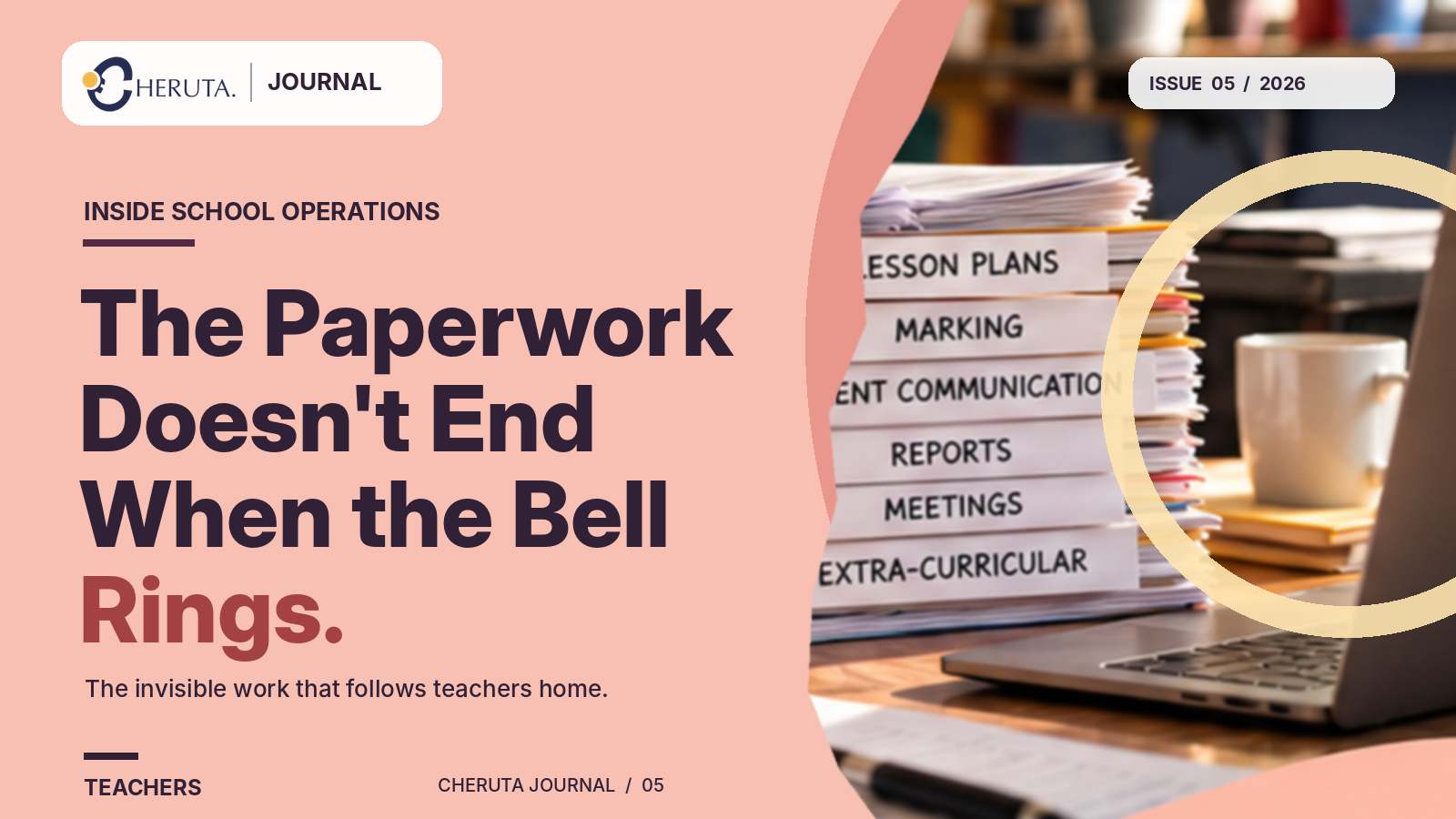
The Paperwork Doesn't End When the Bell Rings.
The school day ends, but planning, assessment, registers and reports still need attention. How much of that work is necessary, and how much is duplication?
 Save
The final bell rings. Students leave. The classroom becomes quieter.
But the teacher's work may be nowhere near finished.
There are lessons to prepare, materials to organize, assessments to review, student progress to consider, records to update and questions from families to answer.
One sharp, practical dispatch every two weeks.
Tuition collection, bursar workflows and modernising school operations without the headache.
Some of this work is essential to good teaching.
Some of it may be the same information being rewritten for another form, another report or another system.
Where does professional teaching work end and avoidable administration begin?
The work nobody sees during the lesson
A strong lesson rarely begins when the teacher walks to the board.
Before that moment, somebody has considered the objectives, materials, teaching approach and ways to check understanding.
For a lesson about fractions, a teacher might need paper shapes, a practical demonstration, questions to reveal misconceptions and different levels of support for learners who need them.
After the lesson, the teacher may need to reflect on what worked, what needs revisiting and which students require further help.
That is not pointless paperwork. It is part of professional instruction.
The challenge begins when the same work must be copied into unrelated templates, rewritten for several approval processes or entered into multiple systems that do not communicate.
Administration can become a significant source of stress
This concern is not limited to one school or country.
In the OECD's Results from TALIS 2024, 52% of teachers across the participating education systems reported general administrative work as a source of stress, on average. This international figure should not be treated as a measurement of Jamaican teachers specifically, but it illustrates how substantial the issue can be.
The OECD distinguishes general administrative work from teaching itself. Tasks such as attendance records, forms and routine school management can be necessary, but their burden deserves attention.
The question is not whether teachers should be accountable.
It is whether the work required to demonstrate accountability has been designed intelligently.
One lesson, several disconnected records
Consider the path from planning to instruction to assessment.
The teacher prepares a weekly lesson plan. A classroom worksheet is created separately. The same objectives are copied into a homework record. Assessment results are entered somewhere else. At reporting time, relevant information must be assembled again.
Each step has a purpose.
But there is no educational advantage in retyping the same objective simply because the next form does not know what came before it.
A connected workflow could allow approved lesson information to support the preparation of related classroom activities while leaving the teacher fully responsible for checking quality and appropriateness.
It could also help keep records aligned as work moves from planning to assessment.
Technology should support professional judgment, not pretend to replace it.
Printing still matters
Not every classroom activity belongs on a screen.
A young learner may need space to write, draw, fold shapes or solve a problem by hand. A teacher may need a physical register or lesson plan book. A supervisor may need a clear printed record for review.
The false choice between paper and digital systems can distract from the real objective.
Good school operations should make it easier to produce the right format for the task.
If a teacher has already prepared the underlying information, creating a professional print-ready document should not require rebuilding the content in another application.
The format may change. The work should remain connected.
Three questions school leaders should ask teachers
What information are you entering more than once?
Repeated entry is a practical place to look for unnecessary administrative workload.
Which documents take the most time to prepare?
The answer may point to formatting and retrieval problems rather than teaching problems.
Which tasks genuinely help students learn?
Not every record can be removed. But its purpose should be understood, and the process should be proportionate to its value.
These conversations should be opportunities to improve the school day, not exercises in blaming staff for using imperfect systems.
Give good teaching more room
Teachers do far more than deliver information.
They prepare, observe, explain, encourage, assess, adapt and communicate. Their professional work deserves thoughtful support.
When school processes are disconnected, teachers can lose time to work that produces little additional value.
When records and teaching materials connect appropriately, there is an opportunity to reduce that duplication without reducing standards.
The goal is not a classroom with no paperwork.
The goal is a school where the paperwork serves the teaching, rather than the teaching constantly serving the paperwork.
Inside School Operations
Inside School Operations is Cheruta's editorial series on what it takes to run a school well.