Everybody Wants Digital. Nobody Wants Another Password.
Why More School Software Can Mean More Work | Cheruta
 Save
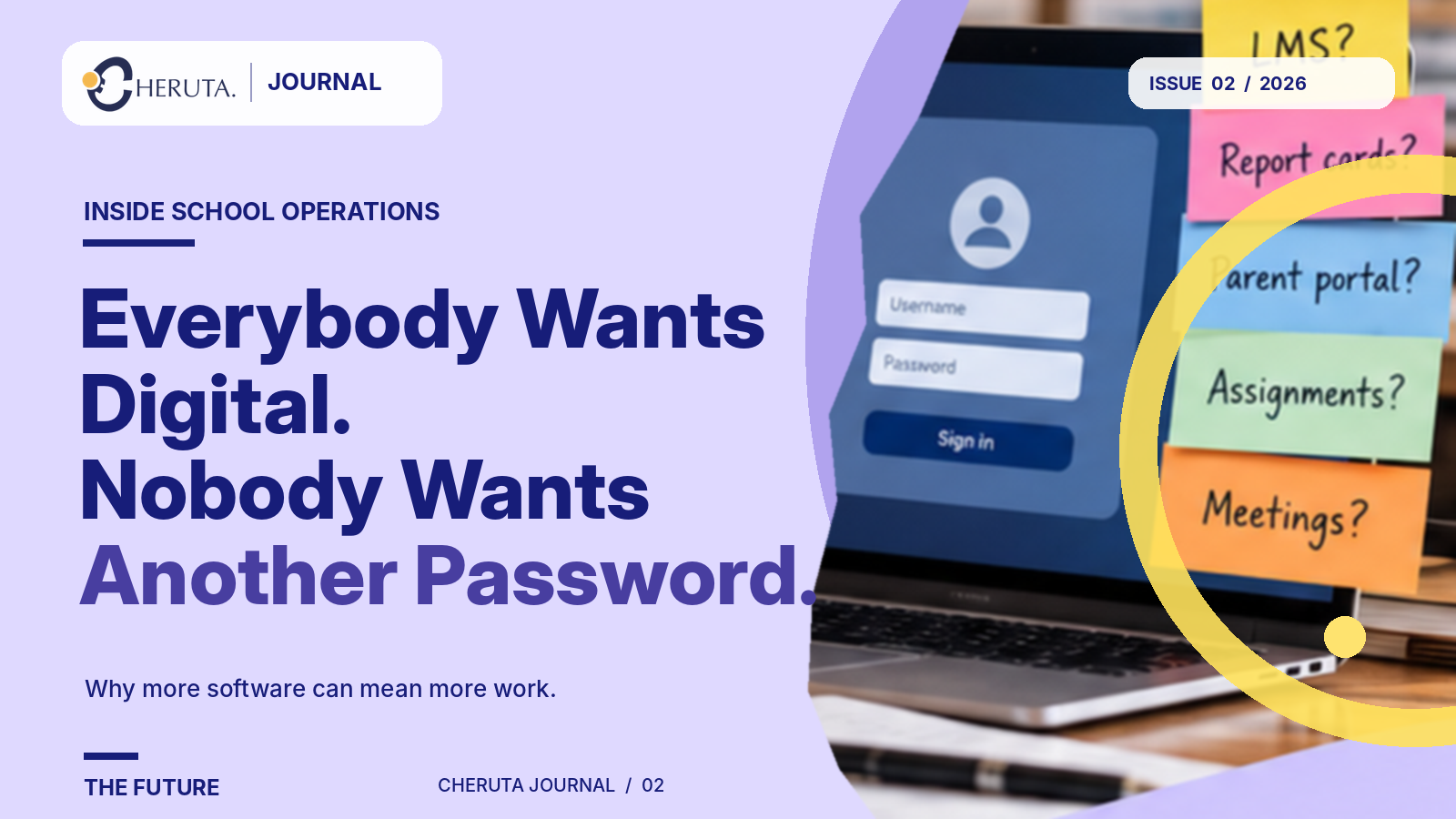
Everybody wants schools to go digital.
Parents want convenient access to information. Teachers want less paperwork. Principals want a clearer picture of daily operations. Bursars want reliable records. School owners want to know that the institution is running as it should.
Then another application arrives.
One sharp, practical dispatch every two weeks.
Tuition collection, bursar workflows and modernising school operations without the headache.
There is a new login, a new password, another set of instructions and, sometimes, another place to enter the same information.
The school has more technology. But does it have less work?
A digital process can still be a disconnected process
Moving information from paper into software is an improvement in some circumstances. A digital register is easier to search than a handwritten page. An online application can reduce the need for families to visit the office. A digital receipt can be easier to retrieve than a paper copy.
But each individual improvement can become a separate island.
Consider a normal school morning. A teacher records attendance in one place. The office needs that attendance for its records. A separate lunch process needs a headcount. A family calls to ask whether the child arrived. Leadership wants the daily totals.
If each person must ask for an update, copy a list or re-enter names, the school has changed the format of the work without necessarily changing the work itself.
The problem is not the number of screens. It is the number of times the same fact must be reconstructed.
The password is a symptom, not the diagnosis
When a teacher says, "Not another password," it can sound like reluctance to adopt technology.
Sometimes it is simply a practical observation.
Another account may mean another training session, another support request and another deadline to remember. If the application is disconnected from the rest of the school day, the teacher must find time to maintain it in addition to existing responsibilities.
Secure accounts and appropriate access controls remain essential. The solution is not to share passwords or remove safeguards. It is to design access and workflows around the people who actually use them.
A teacher should not need the same permissions as a bursar. A parent should not see confidential staff information. A principal needs a broad institutional view without having to impersonate every other user.
Well-designed technology respects those differences while reducing unnecessary effort.
What should happen when information is entered once?
Take student admissions.
When a family submits information and the school accepts the application, the approved details should become part of the appropriate student and household records. Staff should not have to type the same address and contact numbers into several independent systems.
Or take a school payment. Once it is genuinely verified and allocated, the parent-facing balance, receipt record and finance team's account view should reflect the same transaction.
The same principle can guide academics. Teachers should be able to prepare a lesson, connect relevant classroom materials and carry the appropriate work into assessment without manually recreating everything.
These are not arguments for collecting more data. They are arguments for using necessary information responsibly, consistently and with clear permission boundaries.
Five questions before a school adopts another platform
Before adding software, school leaders can ask:
1. Which task will this remove?
A new feature is not the same thing as a reduced workload. Identify the step staff will no longer need to perform.
2. Who will maintain the information?
If three departments must update the same record independently, the system has created a reconciliation problem.
3. What happens when something changes?
A new phone number, approved pickup person or corrected charge should reach the authorized people who depend on that information.
4. Who needs access, and to what?
Convenience must not override student privacy or school accountability. Role-appropriate access should be part of the design.
5. Can staff use it on a busy day?
A workflow that looks impressive in a demonstration but slows down morning registration may not survive the ordinary realities of a school term.
The real measure of digital progress
The value of school technology should not be measured by the number of applications installed.
It should be measured by what becomes simpler, more reliable and more connected.
That includes fewer avoidable requests for information, clearer records, less repeated entry and better visibility for the people responsible for decisions.
The ambition should not be to make every school task digital merely for the sake of it.
It should be to make the school day work better.
Because nobody wants another password just to do the same job twice.
Inside School Operations
Inside School Operations is Cheruta's editorial series examining the decisions, people and systems behind better-run schools.